


Unreal MCP Server – 370+ AI Tools for UE5 Editor Automation via MCP – Unreal Engine
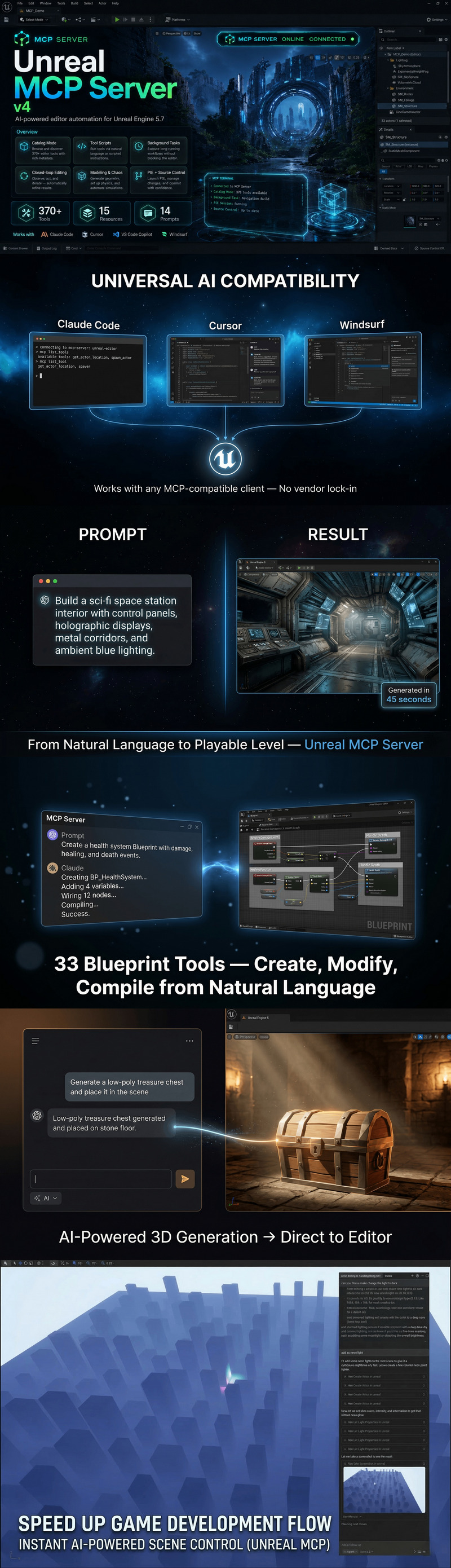
Unreal MCP Server – 370+ AI Tools for UE5 Editor Automation via MCP – Unreal Engine
Connect Claude Code, Cursor, Windsurf, Claude Desktop, VS Code (Copilot), Antigravity, OpenCode, or any MCP-compatible AI agent directly to the Unreal Engine 5.7 Editor.
The v4 release ships 378 editor tools across 54 categories, plus 15 context resources and 14 workflow prompts via JSON-RPC 2.0 over Streamable HTTP — turning your AI assistant into a true co-developer for level building, gameplay scripting, cinematics, VFX, audio, networking, animation, UI, source control, automated testing, runtime debugging, modeling, material layers, Chaos destruction, and MetaHumans.
What’s New in v4 (vs v3) v4 is the agent-native release — rebuilt around how AI agents actually work. Same workflow, far cheaper context, far safer multi-step editing.
Catalog mode (default) — ~95% less agent context
tools/list returns 4 discovery meta-tools + ~30 core tools (~3K tokens) instead of all 378 schemas (~60K tokens). Agents discover the rest on demand via search_tools, list_tool_categories, and get_tool_schemas. Everything stays callable. Set ToolExposureMode = Full for the old behavior.
run_tool_script — multi-step programs as one transaction
Sequential tool calls with result references (save_as / “$var.field”) and foreach loops, executed in ONE editor transaction (all-or-nothing, rolled back on first failure). A 24-actor level blockout becomes a single call and a single Ctrl+Z — killing the N-round-trip problem for batch work.
Background tasks — long ops no longer block
Long-running tools (lighting/nav builds, fracture, remesh, PCG execute, fal.ai generation, automation runs) return {task_id, status: “working”} after a 3s grace window. Poll get_task_status for progress, abort with cancel_task, enumerate with list_tasks. Implemented as tools, so every MCP client works without capability negotiation.
Closed-loop graph editing — agents verify their own edits
describe_graph returns full Blueprint topology (nodes + pins + deduplicated edge list + compile status) in ONE call, replacing N×get_node_pins round-trips. Plus get_execution_paths, move_node, delete_nodes, comments, reroutes, find_orphaned_nodes, list_node_types, and list_actor_components / get_component_info.
Modeling & Chaos are now real (were schema stubs in v3)
Modeling (5): polyextrude, polycut, boolean, uv_unwrap, remesh — implemented via GeometryScript, with before/after triangle counts.
Chaos: chaos_create_geometry_collection and chaos_fracture (voronoi / cluster / uniform / planar) now execute for real; chaos_apply_force applies runtime impulses.
Structured output everywhere
Every JSON-returning tool ships structuredContent alongside human-readable text. Structured errors carry a machine-readable {code, hint, did_you_mean[]} — agents switch on code for recovery flows instead of regexing strings, cutting retry loops dramatically.
Universal undo
Every mutating tool now runs inside its own named MCP: <tool> editor transaction. Ctrl+Z works as expected; multi-step scripts collapse into one undo step.
Hardened core
Request body size limit (HTTP 413 before parsing), tool-call timeouts (structured timeout error), exception guards (a throwing tool returns a structured internal error instead of crashing the editor), idle-session garbage collection, a real BindAddress setting, and DNS-rebinding defense via Host-header validation.
Quality guarded by a registry-wide test matrix
MatrixSpec generates contract tests over the ENTIRE registry. New tools are covered the moment they register; it caught a v3 editor crash and 5 silent bugs during development. export_tool_docs regenerates the per-tool reference from the live registry so docs can’t drift.
Redesigned status bar
Key Features:
378 Editor Tools across 54 categories — Actors, Materials, Material Layers/Graph, Blueprints, Sequencer, Landscapes, Foliage, Niagara, Audio, MetaSounds, MetaSound Graph, Physics, Chaos, Navigation, PCG, GAS, Enhanced Input, Networking, AI Behavior Trees, AnimGraph, StateTree, Control Rig, CommonUI, AI 3D/Image gen, Source Control, Test Authoring, Runtime Debug, PIE, Modeling, MetaHuman, plus the v4 Meta/Tasks discovery layer.
Catalog Mode — progressive tool disclosure cuts a fresh session’s tool-definition cost ~95% (~3K vs ~60K tokens) while keeping all 378 tools callable.
Tool Presets — Full / Scene Building / Gameplay / Minimal / Catalog. Switch instantly to manage AI context cost.
Multi-step tool scripts — run_tool_script runs a sequence (with variables and loops) as ONE all-or-nothing editor transaction.
Full Undo Support — every mutating operation is its own named editor transaction; scripts collapse into one undo step.
Universal AI Compatibility — Claude Code, Claude Desktop, Cursor, VS Code (Copilot), Windsurf, Antigravity, OpenCode, and any MCP-compatible client. Streamable HTTP + SSE — no vendor lock-in.
15 Context Resources — project data, level hierarchy, selected actors, performance stats, capability detection, undo history, and more.
60 Blueprint Tools — components, variables, wire nodes, set properties, full graph read-back, exec-path tracing, and cleanup.
Source Control Aware — works against any provider Unreal supports (Perforce, Git LFS, Plastic, Subversion).
Production-grade safety — bearer-token auth, origin allow-list, scope gating, structured errors, cooperative cancellation, dry-run, request size limits, tool-call timeouts, exception guards, session GC, DNS-rebinding defense.
What’s Included:
Full C++ source code with extensible architecture
378 tools across 54 categories
5 tool presets (Full / Scene Building / Gameplay / Minimal / Catalog)
15 read-only context resources
14 reusable workflow prompts
AI-powered image generation and text/image-to-3D via fal ai
STDIO bridge for non-HTTP clients (Claude Desktop)
Live status bar indicator with one-click Copy Claude Code Config
Bearer-token auth, origin allow-list, scope gating, rate limiting
Registry-generated tool reference (export_tool_docs) and comprehensive documentation
Tool Categories (54) Core — Actor (16), Editor (7), Asset (6), Level (6), Asset Management (7), Batch (3) Scene Building — Material (5), Material Graph (8), Material Layers (4), Static Mesh (7), Environment (4), Modeling (5) Scripting — Blueprint (60), Python Bridge (1), Search (2) Cinematic — Sequencer (12), Animation (5), Anim Graph (14), Control Rig (2) World Building — Landscape (3), Foliage (4), Spline (7), World Partition (2), Spatial (10), PCG (9) VFX & Audio — Niagara (3), Audio (3), MetaSound (6), MetaSound Graph (8) Simulation — Physics (9), Navigation (3), Chaos (5) Characters — MetaHuman (4) Data — Data Tools (6) UI — Widget/UMG (15), CommonUI (4), UI Image (2) Gameplay — GAS (8), Enhanced Input (6), Game Framework (6), Gameplay Tags (3), State Tree (5), PIE (9) Networking — Networking (5) AI — AI Tools (8), 3D Model (3) DevOps — Source Control (8), Test Authoring (5), Runtime Debug (7) Workflow — Macro (6), Build (7), Engine API (3), Performance (4) Agent (v4) — Meta & Tasks (8)
Plugin Dependencies (auto-enabled) EditorScriptingUtilities, Niagara, PCG, EnhancedInput, SourceControl, FunctionalTesting, GeometryScripting, Fracture, GameplayAbilities (optional), PythonScriptPlugin (optional)
Technical Specs
Protocol: MCP spec 2025-06-18, Streamable HTTP
Transport: JSON-RPC 2.0 over HTTP (default port 13579) + SSE fallback
Engine Support: Unreal Engine 5.7 (Windows, macOS, Linux)
Threading: All UE API calls automatically dispatched to the game thread
Source Code: Full C++ access included
Auth: Bearer-token + origin allow-list (localhost-only by default)
Features:
– 378 editor tools across 54 categories controllable via AI
– Catalog mode (progressive disclosure): ~95% lower agent context cost; all tools stay callable
– run_tool_script multi-step programs run as one all-or-nothing editor transaction
– Pollable background tasks for long ops (get_task_status / cancel_task / list_tasks)
– Closed-loop Blueprint graph editing (describe_graph, exec-path tracing, node editing)
– Structured output + error taxonomy (code, hint, did_you_mean) on every tool
– Universal per-tool undo (each mutating tool is its own named transaction)
– 5 tool presets (Full, Scene Building, Gameplay, Minimal, Catalog)
– 15 context resources; 14 reusable workflow prompts
Code Modules: UnrealMCPServer (Editor), UnrealMCPServerTests (Editor)
Number of Blueprints: 0
Number of C++ Classes: [VERIFY – was 56 in v3; higher in v4]
Network Replicated: No
Supported Development Platforms: Windows: Yes, Mac: Yes, Linux: Yes
Supported Target Build Platforms: N/A (Editor-only plugin)
Supported Unreal Engine Versions: 5.7
Notes: Requires an MCP-compatible AI client (Claude Code, Cursor, etc.) installed separately. Editor-only plugin; does not affect packaged builds. Full undo support. Dependencies: EditorScriptingUtilities, Niagara, PCG, EnhancedInput, SourceControl, FunctionalTesting, GeometryScripting, Fracture, GameplayAbilities (optional), PythonScriptPlugin (optional).